Solo Leveling Chapter 1 Review: A Weak Hunter at the Dungeon’s Door
Solo Leveling Chapter 1 introduces Jinwoo through low-rank work, recurring injuries and a raid party that knows he is the weakest among them. Its quiet entry point makes the first dungeon feel like a job with real costs before it becomes a fantasy of power.
Editor-in-Chief: Satya Prasad
Spoiler notice: this article discusses released installment events described by the sources.
Chapter 1 is an effective beginning because it gives Jinwoo a material reason to keep taking dangerous work before offering any promise of a power-up. The rank system and quick cast introductions can feel familiar and compressed, but the chapter's threshold ending turns a simple setup into a clear invitation to continue.
A low rank becomes the chapter’s starting condition
Solo Leveling does not introduce Jinwoo with a triumphant win. The official English listing and the chapter summaries place him at the bottom of the hunter hierarchy, already familiar with pain and failure before the raid begins. That decision makes the fantasy’s first step unusually plain: Jinwoo is not yet a chosen one, a secret powerhouse or even the team’s dependable fighter. He is the person everyone expects to be hurt.
The label “weakest” is a useful shortcut, but it can also flatten a protagonist if the story treats it as a joke and nothing more. Here, the chapter makes it a social position. Other hunters know his reputation, and the party is built around people with more experience and stronger abilities. Jinwoo is visible because he is useful as a body in the roster, yet easy to overlook as a person. That tension gives the title’s promise a human starting point.
Survival is tied to bills, not glory
The official volume description identifies the obligations behind Jinwoo’s work: his mother’s hospital care and his sister’s schooling. The chapter guide likewise describes him taking raid income because the alternative is not a safer adventure or a more fulfilling career; it is a household with needs he cannot ignore. This motive is familiar in fantasy, but it changes the tone of his risk. He is not chasing an abstract ranking or trying to impress a guild. He is trying to keep ordinary life going.
That practical reason also gives the series room to make its later progression feel like an answer to something concrete. The wish to become stronger can grow out of the wish to stop being a liability and to protect the people who depend on him. The weakness in this first chapter is that the family stakes arrive mainly as compressed context, rather than as an extended domestic scene. The information is clear, though the emotional connection is something the story still needs to build.
A raid party has its own pecking order
The opening introduces the raid as a workplace made up of people with different ranks, roles and tolerances for danger. Jinwoo’s healer, the experienced party leader and the other hunters give the scene more texture than a lone hero entering a dungeon. The chapter guide records the way the group treats his repeated injuries as a known part of the job. Their reactions establish that his weakness is not a secret discovery; it is part of the reputation he carries into the room.
This quick social map is efficient. It tells a new reader why Jinwoo can keep joining raids while still being the least powerful person in them, and why the party cannot simply turn into an equal band of friends. There is a trade-off: the number of names and ranks arrives quickly, and some members are initially defined more by their role than their personality. As an opening chapter, that compression is understandable, but the supporting cast will need more than labels to become memorable.
Injury makes the danger ordinary
The repeated injuries are the most direct way the chapter communicates the cost of Jinwoo’s rank. They are not a remote statistic on a hunter registry. He arrives hurt, explains how often he is hurt, and is treated as someone who may need medical help again. That pattern gives the first raid a grim routine. The world’s danger is not surprising to him; it is the price he has already accepted to earn money.
The device is blunt, and there is a risk of making suffering feel like shorthand for character. The chapter does not yet have time to explore how Jinwoo processes each failure, so his persistence can read more as a fact of the premise than a fully dramatized inner life. Still, the ordinary quality of the injuries is useful. It keeps the opening from turning into a clean, heroic test and lets the reader understand that this job has worn him down before the main crisis arrives.
The first chapter keeps its promise small
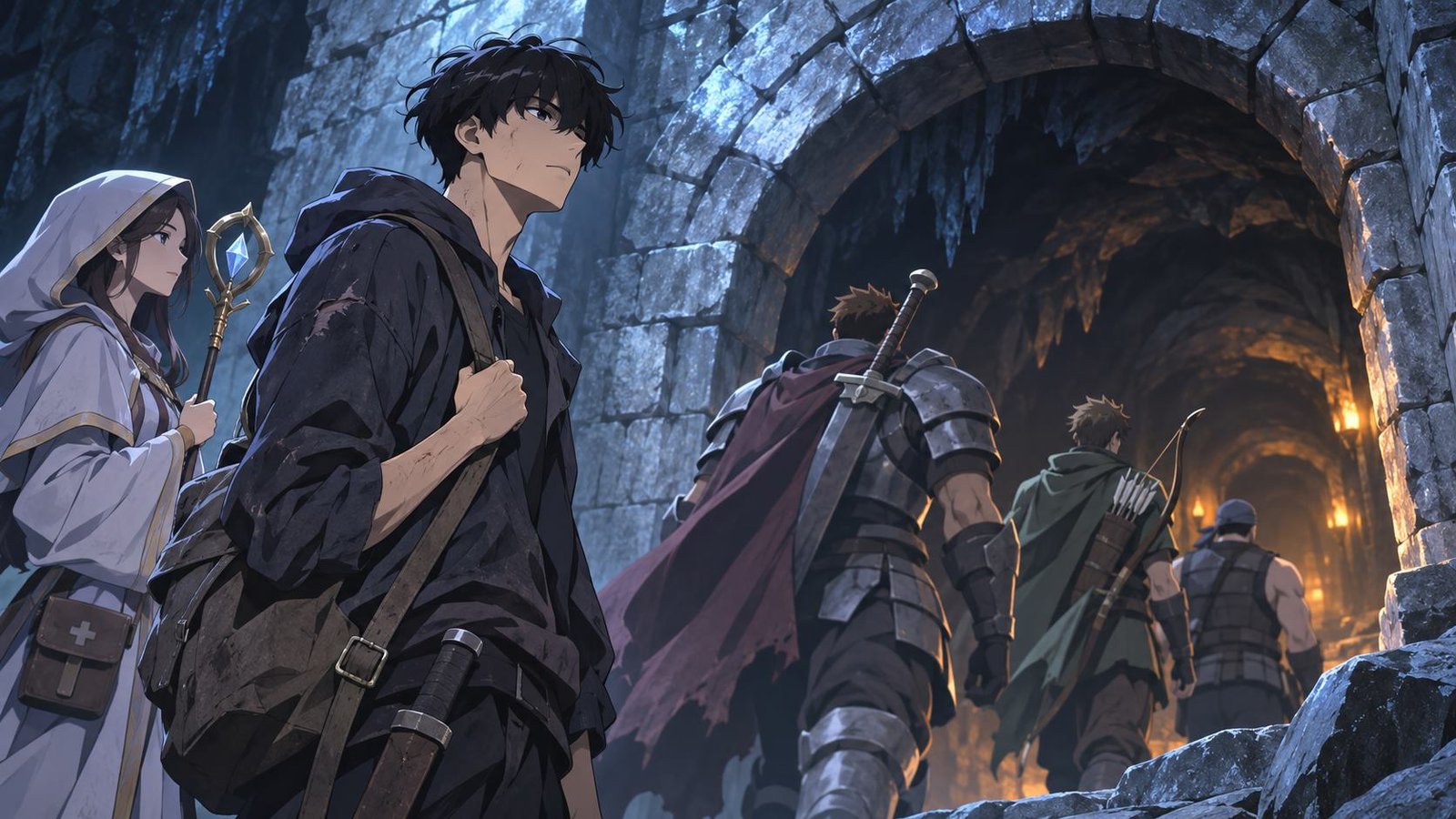
The title in Yen Press’s first volume points toward the Double Dungeon, but the Chapter 1 guide places the ending at the party’s entry into the dungeon. That is a deliberate serial boundary: the chapter spends its pages establishing the person and the work, then stops just as the work begins. It does not try to deliver a full transformation or explain the rules of the larger mystery immediately.
That restraint gives the opening a clear shape, although it may test readers who expect a spectacular hook in the first few pages. A discussion among early readers shows a split in how much setup people want before a series reaches its larger incident. The tension is not simply whether the next room contains danger; it is whether Jinwoo’s reason for entering will keep mattering after the story moves into action. For now, the chapter has earned a reason to follow him through the door.
The supporting cast sets a human scale
The chapter is also careful to place Jinwoo among people who have their own stakes. The healer’s concern, the party leader’s responsibility and the hunters’ conversations sketch a small community built around dangerous paid work. Even when their introductions move quickly, they give Jinwoo something to respond to besides monsters. He is not entering a blank arena; he is joining a group in which rank affects who is trusted, who is protected and who is expected to absorb risk.
This human scale is important for a story whose title advertises individual progression. If the series is only about a solitary character gaining levels, the opening cast could become disposable scenery. Chapter 1 instead makes the reader notice the people around him before any personal system separates him from them. The chapter cannot develop every relationship at once, but it places the question in view: when Jinwoo changes, what happens to the people whose current roles were built around his weakness?
Verdict: a threshold with a reason to cross it
Chapter 1’s strongest choice is its order of operations. It gives Jinwoo a rank, a reputation, a practical reason to keep working and a party that understands the danger before the story opens its larger mystery. None of those ingredients is especially novel on its own. The opening’s appeal comes from arranging them around a protagonist who cannot afford to walk away, rather than around a hero looking for a chance to prove himself.
The setup is compressed and conventional, and the ending is more invitation than payoff. That is a fair limitation for a first installment, not a failure to deliver the series’ eventual power fantasy. This source-based response draws on the authorized English listings, a chapter guide and reader discussion; it does not claim firsthand judgment of every page’s artwork. The best reason to continue is simple: the person entering this dungeon already has something to lose.
Research sources and release verification
Research checked . The publisher establishes release facts; independent sources inform the analysis above.
Only the publisher or authorized streaming service controls access, release times and language options.
Open the official installment listing