Fool Night Anime: Story, Manga Origins and Netflix Release Guide
Fool Night arrives on Netflix November 26, 2026. Explore the disturbing sci-fi premise, the manga by Kasumi Yasuda and the SUNRISE–SHAFT collaboration.
QUICK ANSWER
What would a society ask of people who have very little power left to refuse? That question sits at the center of Fool Night, a science-fiction story where a world deprived of sunlight has developed a horrifying way to produce oxygen. The new anime adaptation arrives on Netflix on November 26, 2026, and its premise is
Source record: Read the original source
Overview
What would a society ask of people who have very little power left to refuse? That question sits at the center of Fool Night, a science-fiction story where a world deprived of sunlight has developed a horrifying way to produce oxygen. The new anime adaptation arrives on Netflix on November 26, 2026, and its premise is much darker than the familiar excitement of a futuristic technology breakthrough.
The production is a collaboration between SUNRISE and SHAFT, which Netflix describes as the studios' first joint project of this kind. The series adapts Kasumi Yasuda's manga and presents a society where people close to death can be transformed into plants. The official synopsis is already detailed enough to explain the central moral dilemma without inventing the ending.
When is Fool Night coming to Netflix?
Netflix has announced a worldwide streaming launch on Thursday, November 26, 2026. Its November 5 press release says all episodes will become available that day. That is a stronger, more specific claim than a generic “coming late 2026” listing and gives U.S. viewers a definite date to check.
As of this article's November 18 update, the release is still ahead. No review should be written as if the author has watched the finished episodes unless that has genuinely happened through a legitimate advance screening. Official trailers, character materials and production interviews can support a preview, but they cannot substantiate judgments about the completed series' pacing or ending.
Use the Netflix title page for the final American-language and content-rating information when the show goes live. A worldwide premiere does not guarantee identical audio options everywhere.
A future without enough sunlight
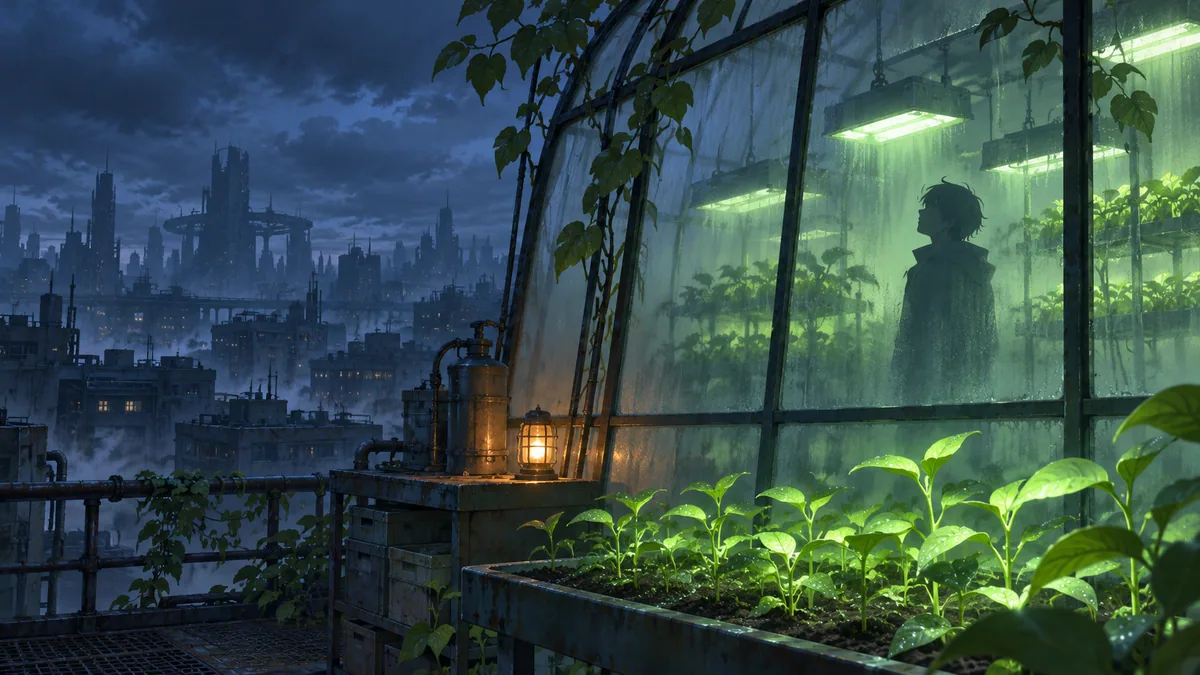
In the world of Fool Night, dense clouds block the sun and much of Earth's vegetation has withered. Humanity faces a severe shortage of oxygen. A process called Transfloration offers a grim solution: people near death can receive implanted seeds and eventually become plants that produce small amounts of oxygen.
The procedure makes the environment and the human body part of the same desperate calculation. In ordinary science fiction, a new technology often solves a problem while producing unintended consequences. Here, the solution is uncomfortable from the beginning because it depends on treating human lives as a resource for the broader population.
That creates an immediate ethical tension. A society can call the procedure a sacrifice for collective survival, but a person facing poverty, illness or social exclusion may experience the “choice” very differently. Even if the technology has genuine benefits, the power to decide who uses it and who receives protection becomes politically and morally important.
Who is Toshiro Kamiya?
Toshiro is a young man marked by deprivation and a difficult upbringing. According to Netflix's official story description, he decides to undergo Transfloration and visits Transflora Medical, where he encounters his childhood friend Yomiko Horai. The fact that he is poor matters to the premise: his decision is being made in a world where survival itself is unequally distributed.
After the procedure, he develops an unusual ability to hear the voices of Spiriflora, humans who have already been transformed into plants. Transflora Medical brings him in as a special temporary worker to use that ability. His circumstances place him at an unsettling intersection between patient, employee and investigative tool.
That position invites a serious question: when a person gains a unique ability through a medical procedure, who gets to decide what they owe the institution that treated them? The answer is not provided by the premise alone, but it is one reason the series looks more socially pointed than a routine dystopian thriller.
What role does Yomiko Horai play?
Yomiko is Toshiro's childhood friend and works at the medical facility where Transfloration takes place. This connection gives the story a human relationship inside a system that could otherwise be described only through its technology. She knew Toshiro before the procedure, which may change how he understands his new circumstances.
A preview should resist predicting whether their relationship becomes romantic or whether either character betrays the other. The official summary establishes their prior connection and her workplace role. Any dramatic outcome beyond that belongs to the unreleased narrative.
The more useful observation is that Toshiro's past and present worlds meet at Transflora Medical. Personal memory is placed alongside an institution trying to make decisions about bodies, resources and social survival.
Why is there a murder mystery?
Netflix's longer synopsis says murders committed by a Spiriflor lead to an investigation involving Toshiro's ability to hear the voices of transformed humans. What initially looks like an unusual medical or ecological premise becomes a mystery with consequences for the system itself.
That combination can do more than supply action. An investigation may force characters to ask how reliable institutional explanations are, what rights transformed people retain and whether those labeled dangerous were ever heard while they were alive. These are questions raised by the setup, not claims about the secret solution.
Readers looking for a spoiler-free overview should stop at the official premise. Even if manga readers know the killer's identity or later revelations, putting those details in a pre-release Netflix guide would undercut the experience for people who are meeting the story for the first time.
Who is making the anime?
Netflix identifies SUNRISE and SHAFT as the animation partners, with Atsushi Yukawa directing and Jin Tanaka handling series composition. Character design is credited to Robert Sato, while the music is by Tatsuya Kato. The opening theme is “Shake! spit out” by Tempalay, and the ending theme is “iki” by Nowlu.
Those credits are notable because the manga's premise needs both an oppressive world and intimate character expressions. SUNRISE has a long history with large-scale science-fiction settings, while SHAFT is known for highly stylized visual approaches. It would be tempting to declare that their collaboration guarantees a particular visual result, but the quality of the completed episodes can only be judged after release.
The interesting editorial question is whether the animation gives viewers room to feel the discomfort of an impossible social choice, or whether the plot moves so quickly that its ethical implications become background decoration.
Where does the manga come from?
Fool Night is adapted from Kasumi Yasuda's manga, serialized in Shogakukan's Big Comic Superior. Netflix's production materials note its critical recognition, including attention from Kono Manga ga Sugoi! and an award at the Japan Expo Daruma Awards.
That publication history matters because the work did not begin as a script built solely for Netflix. The anime is translating an existing approach to bleak science fiction and human drama into a new medium. Readers who want to explore the source should check official English publishing and retailer catalogs for currently licensed editions rather than assuming that every Japanese volume is available in English.
A manga-to-anime comparison will be worthwhile later, particularly because the impact of a transformation or an environmental reveal may differ between a static panel and a moving image.
Who is the show for?
Someone looking for a cheerful fantasy or a straightforward ecological rescue story may be surprised. The premise deals with severe scarcity, coercion, illness and human bodies used for public necessity. A viewer interested in morally uncomfortable speculative fiction, however, may find that exactly the appeal.
It is also worth separating a work's use of unsettling science from a factual claim about medicine or environmental policy. Transfloration is a fictional technology. The story may raise real questions about how societies distribute risk and sacrifice, but it does not describe a currently available biological solution to oxygen shortages.
Bottom line
Fool Night is scheduled to launch all episodes worldwide on Netflix on November 26, 2026. It adapts Kasumi Yasuda's manga through a SUNRISE–SHAFT production and follows a young man who can hear the voices of people transformed into plants. The most compelling reason to watch is the ethical dilemma beneath the science-fiction mystery. Until the premiere, keep any analysis clearly marked as a preview rather than a review of an unseen series.
Based on a linked publisher or official distribution announcement. This report distinguishes confirmed details from information not established by the original source.
View primary sourceSource date / checked: · Rechecked
Found a factual error? Contact the editorial desk.