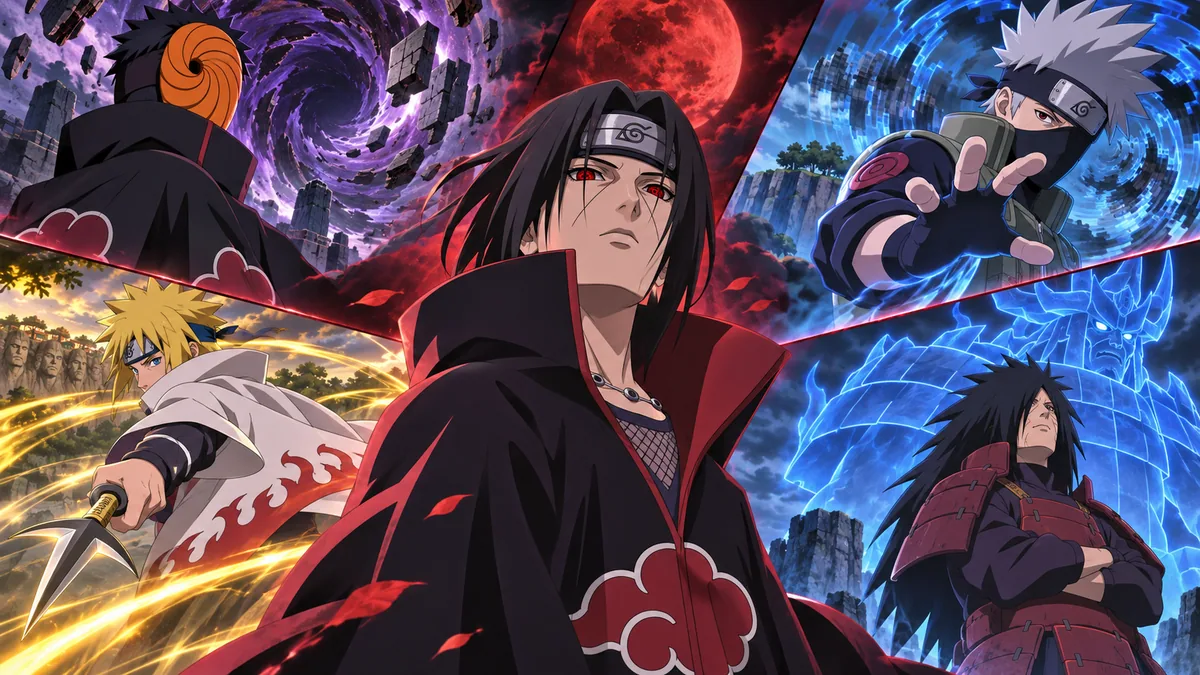
Itachi's Powers Explained: Tsukuyomi, Amaterasu, Susanoo and Izanami
A practical guide to Itachi's Sharingan and Mangekyō abilities, Susanoo weapons, genjutsu and Izanami, what each does, what it costs and what fans misunderstand.
QUICK ANSWER
Itachi's signature techniques include Sharingan-based perception and genjutsu, Tsukuyomi, Amaterasu, Susanoo and the extraordinary Izanami used against Kabuto. His Susanoo wields the Totsuka sealing blade and Yata Mirror defense. None is a universal no-limits victory button; technique conditions, bodily strain, eye costs and the opponent's abilities determine their effectiveness.
Source record: Read the original source
Itachi is powerful because he changes the terms of a fight
Itachi Uchiha is commonly introduced through images of red eyes and the Akatsuki cloak, but that iconography hides a more interesting skill set. He does not simply hit harder than the person standing opposite him. He controls attention, creates false information, makes opponents doubt what they experienced and forces them to react to threats that may already have decided the battle. This is why early encounters with Itachi feel so different from a conventional contest of punches and chakra.
This guide explains his signature techniques in plain language, including the conditions that make them powerful and the limitations the story shows. It discusses events through the brothers' battle and the Fourth Great Ninja War, so later sections contain spoilers. The core distinction to keep in mind is that the regular Sharingan, Mangekyō Sharingan, Susanoo and forbidden techniques do not all work the same way. Calling everything 'Itachi's eye power' hides the decisions that make his fights intelligent.
The regular Sharingan: seeing, anticipating and deceiving
The Uchiha Sharingan supports heightened visual perception and the ability to read or anticipate an opponent's movements. That does not mean it grants literal knowledge of every future event. The eye helps its user process important details very quickly; the person still has to make judgments. Itachi combines that capacity with disciplined movement, shuriken technique and a remarkable talent for genjutsu. He often makes a fight look easier because he has shaped the opponent's choices before the decisive exchange.
The more easily overlooked ability is deception. A thrown weapon, a clone or a brief change in eye contact can turn into a test of what the opponent trusts. The official Naruto retrospective of the Sasuke duel describes apparent injuries that prove to be layered illusions. In that kind of encounter the audience shares the combatant's uncertainty. The lesson is not that Sharingan defeats every fighter. It is that allowing Itachi to dictate the information you act on gives him an immense strategic advantage.
Tsukuyomi: a mental attack that distorts experienced time
Tsukuyomi is associated with Itachi's Mangekyō Sharingan and is among his most frightening techniques because it attacks perception itself. The victim is pulled into an illusion where time and suffering can feel radically different from their duration outside. Kakashi's encounter makes the danger visible: Itachi traps him in an exhausting mental ordeal while the real-world moment is brief. A reader who thinks genjutsu merely means seeing a harmless false picture will miss how serious the consequences can be.
The technique's value comes from its speed and mental pressure, not from causing the largest environmental explosion. It also explains why veterans warn against meeting Itachi's gaze. Yet a prohibition on looking into his eyes is not a complete counter to every move he possesses, and eye-contact strategies depend on the opponent and situation. Tsukuyomi has specific conditions and can be resisted in particular circumstances. The exact rules should be read through demonstrated scenes rather than a fan-invented promise of unconditional control.
Amaterasu: black flames that change the battlefield
Amaterasu manifests as intensely destructive black flames. It is easy to see why fans talk about it as if an unavoidable finishing move had been added to every confrontation. On the page or screen, however, targeting, reaction, movement, defense and the consequences of hitting the environment all matter. The power forces an opponent to solve an urgent positional problem, often making escape or interruption a priority rather than direct attack.
In the fight with Sasuke, Amaterasu shifts the duel from mental trickery to visibly escalating physical danger. That change in scale is part of the drama. But a spectacular attack does not establish that Itachi can hit anyone in any location at any distance with no limitation. Naruto repeatedly depicts unusual defenses, replacements and specialized responses to techniques that initially seem decisive. It is more accurate to call Amaterasu an extraordinary offensive ability whose effectiveness depends on whether the target can be engaged under the right conditions.
Susanoo: protection, weapons and its own demands
Susanoo gives Itachi a giant chakra-based defensive and offensive manifestation. Its appearance changes the matchup because Itachi can withstand attacks that would otherwise reach his body and employ special weapons from behind that protection. In the brothers' battle, it is crucial to his survival of Sasuke's devastating lightning technique. The defensive value is obvious, but it would be a mistake to read that one survival as proof that no power in the Naruto world can ever bypass or outlast Susanoo.
Susanoo is also demanding, particularly for a fighter whose health is already failing. Itachi can use it in extraordinary moments; he cannot treat it as a costless wall that stays active indefinitely in every imagined battle. A useful power guide must ask whether the technique is active, how long its user can sustain it, what the opponent can do to change the situation and whether the user's goals permit a direct finishing attempt. That is where an interesting hypothetical starts, rather than where it ends.
The Totsuka Blade and Yata Mirror are not generic equipment
Itachi's Susanoo is associated with the Totsuka Blade, a sealing weapon, and the Yata Mirror, a defensive shield-like treasure. These are not ordinary metal items that he buys or carries into every mission. They belong to the legendary spiritual arsenal of his Susanoo. The blade matters especially when Orochimaru's power manifests during the Sasuke confrontation; Itachi's response removes a dangerous influence from his brother's future.
The Yata Mirror's reputation leads to exaggerated statements that Itachi's whole body is permanently untouchable from every direction. The more grounded interpretation is that a remarkable defensive tool is shown within the technique. A skilled opponent still has meaningful questions to ask about angle, timing, duration and resource exhaustion. The same applies to the Totsuka Blade: a sealing effect is formidable if it makes contact, but the story does not provide evidence that any opponent can be hit whenever Itachi wishes.
Izanami: Itachi's most revealing technique
Izanami is the strange finishing technique Itachi uses during the confrontation with Kabuto. Rather than overwhelming Kabuto with a larger flame or stronger sword, it traps him in a repeating loop of experience and confronts him with his refusal to acknowledge reality. Its narrative function is different from a straightforward destructive attack. It acts on a pattern of behavior, and the escape condition is tied to the target's acceptance of what they are.
The cost is also severe: the forbidden eye technique sacrifices the vision of the eye used. The official Naruto anniversary account describes how it is prepared and employed against Kabuto to secure the undoing of the Reanimation Jutsu. Reducing Izanami to 'Itachi instantly defeats anyone forever' ignores its setup, purpose and price. A technique with an extraordinary outcome can remain limited by circumstance, preparation and the user's willingness to pay the cost.
Do not confuse Izanami with Izanagi or Kotoamatsukami
Names in Uchiha lore are easy to mix up, particularly when short videos list techniques without context. Izanami and Izanagi are related forbidden ocular techniques, but they do not serve the same purpose. Izanagi alters the user's relationship to an unfavorable reality for a brief period; Izanami creates a looping confrontation with the target's choices. Both have grave eye-related costs. An article that treats them as interchangeable will make the Kabuto encounter difficult to understand.
Kotoamatsukami is associated with Shisui Uchiha, not Itachi's original pair of Mangekyō abilities. Itachi later possesses Shisui's eye and arranges a crow-based contingency that uses the technique. That distinction matters because the crow's intervention in the war is a planned safeguard, not evidence that Itachi was born with every famous Uchiha eye power. The Naruto official Shisui birthday column is an especially useful reference for tracing that chain of custody.
Why doesn't Itachi use his strongest attack constantly?
The short answer is that a shinobi is not a menu of infinite resources. Genjutsu can be situational, Mangekyō techniques carry physical cost, some abilities require careful timing and Itachi's illness limits his stamina. His actual decisions reflect goals more complicated than defeating the nearest enemy as quickly as possible. During the Sasuke fight he wants a particular resolution, and in the war he must undo a controlling technique rather than simply inflict more damage.
There is also the narrative issue of information. Itachi often wins space by making another character misunderstand the battlefield. Displaying an advanced technique immediately can reveal his options, leaving fewer surprises. Not every scene can be extrapolated into a ranking of unrelated characters because Naruto's battles reward particular matchups. A specialist in sealing, perception or domain-like containment can trouble a physically stronger opponent. Itachi is dangerous precisely because he knows those distinctions.
Power comparisons that are meaningful, and ones that aren't
Itachi versus Sasuke can be discussed using their actual duel, but not as a clean test between healthy versions with identical motives. Itachi versus Kakashi has direct early-series evidence about genjutsu and timing. Itachi versus Kabuto can be evaluated through the war-arc events and Izanami. By contrast, Itachi versus a character he never fought is a hypothetical. The story may offer clues, but no official scoreboard resolves how its unseen matchups would play out.
A more useful reader checklist asks which version of Itachi is being compared, whether eye contact is possible, whether Susanoo can be maintained, how an opponent deals with illusion, and what goal each fighter pursues. This turns an endless argument into an intelligible analysis. The conclusion can still be uncertain. A strong piece of fandom writing should feel comfortable saying 'the series does not show that' rather than pretending it witnessed a battle that the creators never depicted.
Frequently asked questions
Is Tsukuyomi the same as Kotoamatsukami? No. Tsukuyomi is Itachi's own terrifying time-distorting genjutsu; Kotoamatsukami originated with Shisui's eye. Is Susanoo his strongest move? It may be his most dramatic combined offense and defense, while Izanami has a uniquely consequential result in a specific encounter. There is no official single-number ranking of these techniques. Does Itachi have an Eternal Mangekyō Sharingan? No, his normal Mangekyō powers are not presented as an Eternal Mangekyō upgrade.
Why did his eyes worsen? Repeated use of powerful Mangekyō techniques has serious costs, compounded by his underlying illness. Did the Totsuka Blade seal Orochimaru? The brothers' confrontation shows Itachi using that Susanoo-associated weapon against Orochimaru's manifestation. Can Itachi defeat every shinobi with one glance? The franchise does not support that universal claim. For original context, begin with the official Naruto retrospectives of his battles and the Fourth Ninja War rather than isolated clips.
Based on the official Naruto anime retrospective of Itachi and Sasuke's genjutsu duel, Amaterasu and Susanoo, with later official war-arc explanation of Izanami. This report distinguishes confirmed details from information not established by the original source.
View primary sourceSource date / checked: · Rechecked
- Naruto official Tsukuyomi confrontation with Kakashi
- Official Naruto anniversary account of Izanami and the Kabuto fight
- Official Itachi birthday column linking key techniques to manga chapters
- Official Shisui column distinguishing Kotoamatsukami from Itachi's own abilities
- VIZ official Naruto English manga directory
Found a factual error? Contact the editorial desk.