Was Itachi a Hero or Villain? The Hardest Moral Question in Naruto
Was Itachi good or evil? A balanced look at his motives, the Uchiha victims, Sasuke's trauma, Danzō's role and why his final confession still matters.

QUICK ANSWER
Itachi is written as a tragic character with protective motives who still commits devastating acts. He acted under coercive political pressure to avert a coup and preserve Sasuke's life, but the massacre, secrecy and psychological harm cannot be made harmless by the late revelation. The story ultimately asks us to weigh duty and love against agency, victims and consequences, not to issue an official hero-or-villain score.
Source record: Read the original source
The question matters because the answer is uncomfortable
Itachi is one of Naruto's most discussed characters because the story gives us two portraits that seem impossible to hold together. In one, he is the older brother who destroys his clan and deliberately wounds the only family member he leaves alive. In the other, he is a frightened young shinobi who fears war, loves his brother and accepts an unbearable burden to prevent a greater catastrophe. Neither portrait is simply fake. The tension between them is what makes Itachi more than a puzzle with a secret solution.
This article is not an attempt to tell readers which emotion they should feel. It is a way to examine an important distinction: an explanation for an act is not a moral pardon for that act. Naruto provides strong evidence for Itachi's protective motives and for the coercive environment that shaped his choices. It also shows enormous harm. An honest hero-or-villain discussion has to begin by admitting both and by keeping the victims visible even when the narrative later moves toward his final confession.
A young boy learns to hate the idea of war
The official Naruto biography follows Itachi back to his experience of battlefield death at a very young age. He is not attracted to violence for its own sake. He imagines a world in which people do not have to repeat the same destruction that shaped his earliest understanding of being a shinobi. This is an unusually sympathetic starting point for a character who will eventually be feared as an international criminal. It tells us that violence and compassion are not distributed neatly among Naruto's heroes and enemies.
His talent complicates the situation. Adults read his exceptional ability as evidence that he can carry responsibilities other children cannot. His clan wants a skilled insider; the village security apparatus wants a useful observer. Itachi begins to inhabit roles that demand obedience before he possesses the authority to change the conditions that make those roles necessary. Calling him a child soldier is an analytical description of this dynamic, not a claim that the franchise uses that specific legal label. He is drawn into an institution that repeatedly turns youth into instruments.
The strongest argument for seeing Itachi as a tragic protector
Itachi hopes to prevent a violent Uchiha uprising from bringing civil war to Konoha, and his loyalty to Sasuke is not invented after the fact. The official Naruto column carefully describes that bond through childhood gestures and the final battle. Itachi understands that opposing the clan will destroy his standing among the people who should have been closest to him. He accepts the identity of a monster because he thinks that story can preserve the village and leave Sasuke a future.
He also demonstrates a willingness to take the blame personally rather than seek public recognition as someone who saved Konoha. That willingness explains why so many viewers experience the final revelation as tragic rather than simply manipulative. He gives up his reputation and eventually his life for an idea of peace. In a world where power so often becomes a demand for glory, the refusal to be praised is meaningful. But sacrifice can be sincere even when the chosen method is morally disastrous.
The strongest argument against calling him a hero
The massacre is not a metaphor. People die, including people who were not the architects of the coup. Itachi kills members of his own family while acting through a political project that would never be tolerable if we were assessing it only by its consequences. The facts that he suffered and was pressured do not erase the suffering of others. Any moral evaluation that discusses only what he surrendered and never what was taken from those who died is fundamentally unbalanced.
Sasuke's survival does not cancel the harm to him either. Itachi lets him grow up under a false understanding, and the narrative shows the damage caused by years of hatred and mental torment. The plan requires Sasuke to make a terrible mistake about the world and then build his identity around correcting it. Even when motivated by protection, this is control. The later confession can explain why Itachi behaved as he did, but it cannot give Sasuke back an untraumatized childhood.
Danzō and the village: when an institution needs a scapegoat
Danzō's influence belongs at the center of this moral accounting because the crisis was not a private argument between siblings. The village tolerated political mistrust and empowered secret actors who treated atrocity as a tool of security. The Uchiha's plan for an armed coup was itself dangerous; that does not make collective slaughter a justified answer. The official Naruto and Shisui materials together make clear that a possible intervention was undermined and the security response hardened into catastrophic violence.
It is too easy to praise Itachi's selflessness while leaving the institutions that used him untouched. That is what the story quietly warns against. A talented person who accepts guilt on behalf of the state may look noble to observers, while the state retains the ability to recruit the next person for a similar act. Naruto's wider interest in inherited conflict gives this problem long reach. Sasuke's later anger at Konoha may be destructive, but it is not incomprehensible once he knows who paid for the village's stability.
The decision tree the story never lets us observe
One way to judge the character fairly is to distinguish choices from outcomes. Itachi could imagine a coup followed by civil war, and he was given a violently narrow menu of alternatives. Those beliefs help explain his decisions. But readers are not shown a parallel version of the story in which negotiation succeeded, or one in which every combatant refused Danzō. No amount of confident fandom debate can turn those counterfactual scenarios into canonical footage.
This limits two common arguments. 'There was absolutely no other possible way' is stronger than the evidence permits. 'He could easily have solved it all peacefully' is also an invention unless someone supplies the process, risks and people required. The more grounded moral point is that a system which corners a young subordinate into choosing between mass violence and anticipated mass violence has already failed. Itachi's individual guilt and the system's responsibility belong in the same discussion.
Did Itachi protect Sasuke, or try to write his life for him?
The clearest evidence of Itachi's love comes through action, not just speeches. The official retrospective recalls small everyday gestures toward Sasuke as a child, his concern over the curse mark and the final moment after their battle. Those details justify saying his attachment was real. But love in Naruto often becomes dangerous when it is mixed with the desire to determine another person's future. Itachi wants Sasuke to live, but also wants him to become a particular kind of avenger and later defender.
When the truth comes out, Sasuke's response shatters that plan. He does not accept the first story he was told, yet he cannot simply return to the innocent world that existed before it. His anger changes direction. This failure is essential to the moral reading of Itachi: if his plan had worked perfectly, the story might look like praise for sacrificing one life to control another. Instead, it shows how a protective intention can become a new source of harm when it denies the protected person knowledge and choice.
His final conversation changes the moral relationship
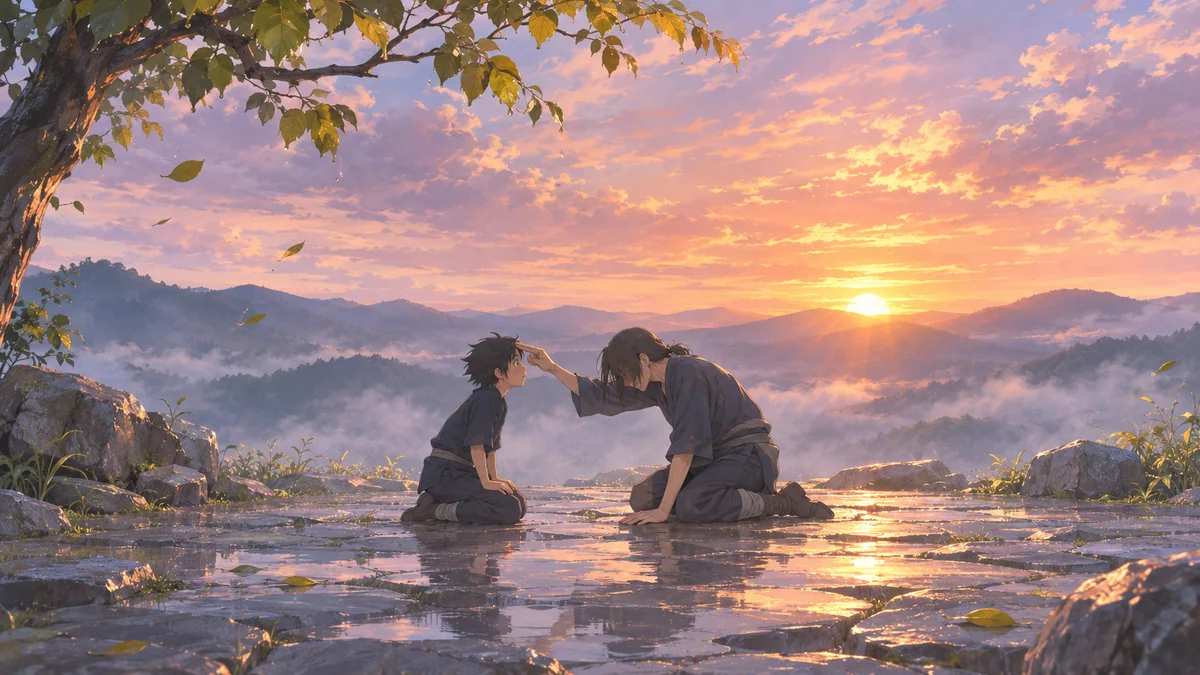
During the Fourth Great Ninja War, reanimated Itachi gets a final chance to speak with Sasuke. That scene matters because it is different in purpose from his earlier manipulations. Rather than stage another illusion about who Sasuke should hate, he tells him the truth and accepts that his brother may never forgive him. The Naruto official war-arc account places this beside Sasuke's subsequent decision to think for himself about the world and his path forward.
That is a profound change, though not a retroactive repair of the past. Itachi finally gives up the project of authoring Sasuke's life. He recognizes that loving someone and controlling their future are not the same thing. The most meaningful part of the farewell is not a clever technique or an added revelation about his power. It is the acceptance that Sasuke has the right to respond in his own way. In a story filled with cycles of revenge, that small surrender of control can be as important as any battlefield victory.
Our moral scorecard: motives, means, costs and lessons
Motives: Itachi sought to prevent war and preserve Sasuke, goals that are understandable and in themselves defensible. Means: he participated in the annihilation of his own clan and orchestrated psychological deception, actions that cause severe harm. Costs: the Uchiha lost lives, Sasuke lost his family and Itachi forfeited the possibility of an ordinary life. Consequences: the immediate political threat ends, but Sasuke's trauma and the village's buried guilt continue to shape the wider story.
That balance sheet is more illuminating than a score of ninety percent hero or ten percent villain. It separates the dimensions that readers are otherwise asked to collapse. The story supports sympathy for someone who was used by powerful institutions. It does not require admiration for what he did to vulnerable people. It also supports anger toward those institutions without proving that any particular alternative timeline would have been painless. A mature character reading can hold those conclusions simultaneously.
Why viewers keep returning to Itachi years later
Many beloved anime characters are memorable because they become stronger. Itachi is memorable because new information makes older scenes feel different. A cold expression can become resignation; an apparent attack can be part of a grim contingency; a seemingly final gesture can recover a memory of childhood. The reveal invites a rewatch, not simply a revised opinion of his power. That is a structural achievement in storytelling.
There is also a recognizable human problem underneath the supernatural abilities: what happens when a person is praised for bearing a secret that should never have been theirs? The official VIZ introduction to Itachi's Daylight novel frames him through the drastically different ways people perceived him, criminal, weapon, hope and lost brother. Each perspective contains a part of his story and misses something essential. The reason the argument continues is that Naruto never allows a single reputation to account for all the damage and love.
Questions without a simplistic verdict
Was Itachi secretly good? He had protective motives and a capacity for love, but that does not make every action good. Is he a villain in Naruto? For much of the story he functions as an antagonist; later revelations deliberately complicate that role. Was the massacre his idea alone? The wider coup and Danzō's coercive security response are essential factors. Did Sasuke forgive him? Their final meeting is a form of emotional reconciliation, but Itachi explicitly makes space for Sasuke not to absolve him.
Can fans reasonably admire Itachi and still condemn the massacre? Yes. Those views are not contradictory when admiration concerns his courage, intelligence or self-criticism rather than endorsement of mass killing. Did Naruto officially declare an ethical winner? No. Itachi's arc works because the story's strongest emotional gesture is not a verdict from a judge; it is a brother finally allowing another brother to choose for himself. That is where our interpretation ends and yours can begin.
Based on the official Naruto retrospective of Itachi's ideals, coerced choices, Sasuke's suffering and final war-arc farewell. This report distinguishes confirmed details from information not established by the original source.
View primary sourceSource date / checked: · Rechecked
- Naruto official history of the Uchiha coup, political discrimination and Itachi's hidden role
- VIZ publisher introduction to Itachi's Story: Daylight and the multiple ways he was perceived
- Official Shisui retrospective on a failed non-massacre intervention
- Official war-arc retrospective of Itachi and Sasuke's final conversation
- Official Naruto episode I Will Love You Always
Found a factual error? Contact the editorial desk.